Networked sensing
Many sensors, one radio picture.
Radio waves travel almost in straight lines. How far a sensor sees depends on terrain, antenna height and the emitter, and hills or buildings leave blind spots behind them. To watch a border, a base perimeter, a city or a convoy route, you need several sensors working together. Our sensors are built for exactly that, and CloudSDR is the network that links them.
How it works
- Each sensor does its own analysis. Detection, measurement and identification happen on board. While a sensor is cut off, it keeps its signal data on board; when the network offers a storage service, it sends them there automatically.
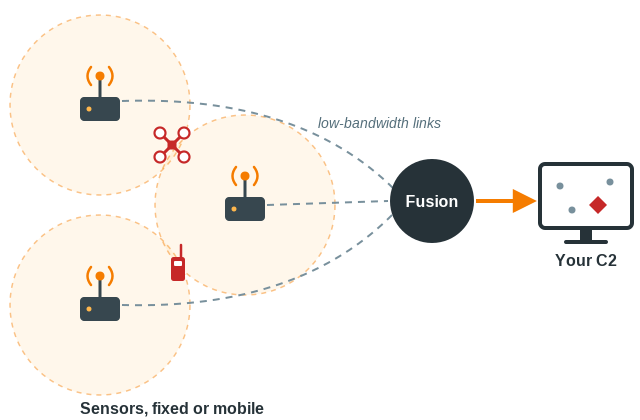
- Only results travel. Sensors send detections and measurements, not raw signals. Video is a result too: it is encoded on board and sent on request, like the signal samples your analysts may ask for. A wired network, 4G, satellite or your tactical radio data links can carry it, over IP or through a serial gateway.
- The network brings together what all sensors see. Detections of the same drone link by several sensors are already confirmed and merged; the same for other emissions is in development.
- Your C2 receives the results of the whole network through standard interfaces.
What makes it different
- Light on bandwidth. Processing happens at the edge, so narrow links are enough, even across a large area.
- Resilient. If a link is cut, each site keeps working on its own and resynchronizes automatically when the link returns.
- Services on offer, used on demand. Every element of the network announces what it can offer: storage, classification, analysis, fusion. Sensors and operators call on these services when they need them, and capabilities switch on and off as links and sensors come and go.
- Confirmed alerts. Several sensors seeing the same drone link confirm each other, so operators can trust what they see. Other emission types are in development.
- Re-tasked on the fly. An alert from one sensor can trigger a closer look by others, automatically or from the command post.
- One fleet, one client. Operators drive every sensor from our operator client for Windows and Linux, as if all were on the same local network; each sensor also has its own web interface. Several operators can work at the same time.
- A mixed fleet. Fixed and vehicle-mounted sensors, wideband sensors and drone detectors share the same network and the same language. A new sensor type joins without changing the rest.
- Your C2 stays in charge. We feed your command and control system; we do not replace it. Our design isolates the C2 link in a single connector.
- Open. C++ and Python libraries let integrators connect their own sensors and software.
- Critical assets stay at the rear. Field sensors do the routine work. Classification software, analysis tools and expert analysts stay in a protected location and serve the whole network, instead of being deployed on every sensor. Learn more
- Interoperable. Third-party analysis software can use any receiver of the network as if it were a local radio, and third-party classifiers can send their verdicts back into the network. Learn more
Operational and demonstrated
CloudSDR has been demonstrated end to end: several drone detectors confirming each other, sensors re-tasked on alert, one continuous video stream delivered to a third-party C2, and sites that keep working when cut off. Read the news
Interfaces
- Web interface on each sensor, nothing to install, and an operator client for Windows and Linux to run the whole fleet
- REST API, MQTT messages and Cursor-on-Target
- Video as MPEG-TS streams with MISB KLV metadata
- C++ and Python libraries for direct integration
Coming next
Locating emitters from the network is in development.
Export control
Some products, software, technical data, training and services are subject to French regulations and to French and EU export control. Contact us to discuss your needs: we handle the licensing process with the French authorities.
Planning a network of sensors?
Tell us about the area to cover and the links available. We will propose a layout and a first step you can test.