CloudSDR
The network that links our sensors, your operators and your C2.
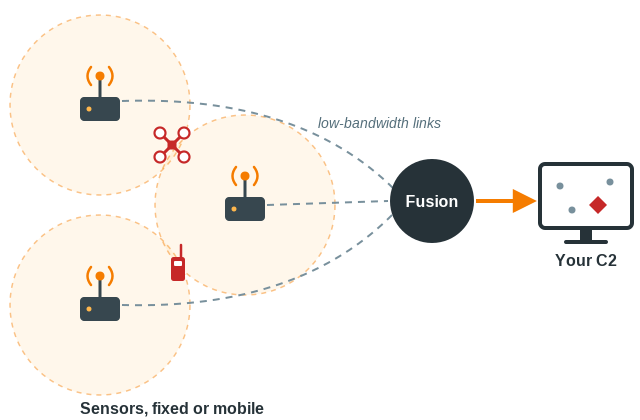
CloudSDR connects sensors, processing services, storage and operator stations. Operators drive a fleet spread over many sites as if it were on one local network, from our operations software for Windows and Linux. Each sensor analyzes signals on board, so only results travel, even over narrow links; video is encoded and sent on request.
For whom? Anyone deploying more than one sensor, and integrators who need to bring radio detections into a command and control system.
What you get
- One fleet, one client: find, monitor and drive every sensor from one place, with our operator client for Windows and Linux. Several operators can work at the same time and share data streams or their observations.
- Self-describing sensors: each sensor publishes its own commands and capabilities, so a new sensor type appears without new software on the operator side.
- Live streams: raw streams, spectrum, video and detections in one compact format suited to narrow links.
- Services on offer, used on demand: every element of the network announces what it can offer (storage, classification, analysis, fusion), and the others call on it when they need it. Capabilities switch on and off as links and sensors come and go.
- Multi-site operation: each site keeps working if its link is cut, and resynchronizes automatically when the link returns.
- Gateways for low-rate links: your tactical radios, LoRa or satellite modems, connected over IP or through a serial interface.
- Data where you need it: kept on board while a sensor is cut off, then sent automatically to a storage service as soon as the network offers one. Transfers are verified.
- Open to integrators: C++ and Python libraries to connect your own sensors and software.
Critical assets stay at the rear
Sensors in the field are exposed: they can be lost or damaged. With CloudSDR, they do not need to carry your most valuable tools. Field sensors do the routine work: detection, measurement, first identification. Your classification software, analysis tools and expert analysts stay in a protected location and work for the whole network.
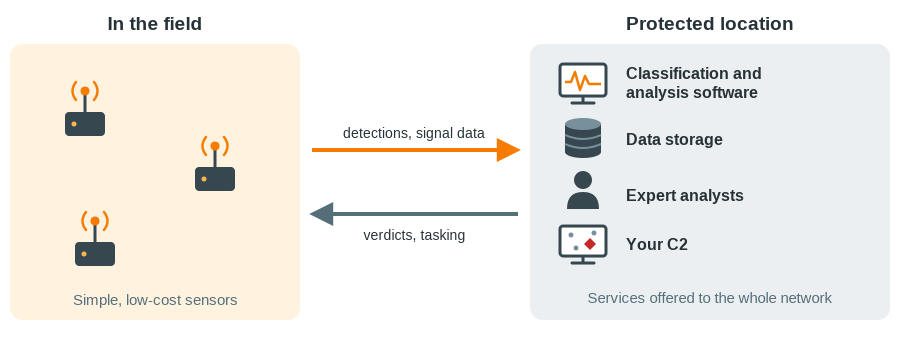
- Sensitive tools stay at the rear. Specialized classification software and your analysts' know-how stay at the protected site. They do not need to be deployed on every field sensor, which carries only what routine work requires. Signal data can follow too: when the network offers a storage service at the rear, sensors send it there as soon as the link allows.
- One analysis station for many sensors. A single installation of your analysis software, and a single team of experts, can work with sensors spread across a whole territory.
- Classification on demand. An operator sends a short sample of an emission to a classification service at the rear. The service asks a third-party classifier and our own detectors, then publishes the verdict back into the network, with the alternatives it considered. Every operator, and your C2, see the same result.
Works with the tools you already use
CloudSDR is designed to interoperate, not to lock you in.
- Remote receivers become local radios. A plug-in makes any receiver of the network appear in third-party analysis software as if the radio were plugged into the analyst's workstation. The analyst tunes it live, from the rear, with GNSS time-stamping.
- Third-party classifiers can be connected to the classification service, alongside ours.
- Standard outputs for your C2: REST API, MQTT, Cursor-on-Target, MPEG-TS video with MISB KLV metadata.
- Other tools on request. We develop plug-ins for the analysis software you already use.
Operational and demonstrated
CloudSDR is the common network layer of all our sensors. It has been demonstrated end to end: several drone detectors confirming each other, sensors re-tasked on alert, and one continuous video stream with standard metadata delivered to a third-party C2. Read the news
Technical summary
- Runs on Linux (Debian, Ubuntu), on a dedicated hub appliance or on your own servers
- A single network port; automatic discovery on the local network
- Outputs: web interface, REST API, MQTT, Cursor-on-Target, MPEG-TS video with MISB KLV metadata
- Client libraries: C++ and Python
- Plug-in for third-party signal analysis software (Windows)
Price
On request, depending on the number of sensors and sites.
Export control
Some products, software, technical data, training and services are subject to French regulations and to French and EU export control. Contact us to discuss your needs: we handle the licensing process with the French authorities.