Defense and security
Networked radio sensors
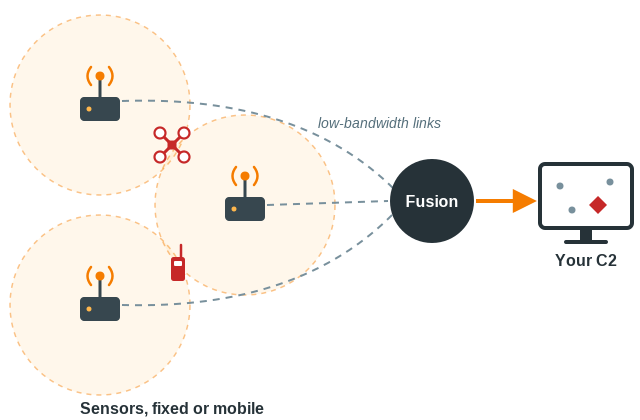
A single radio sensor only sees as far as its horizon. Ours work as a team: each one spots radios, drones and jammers on its own, and the network brings their results together for your command post.
Why a network changes the picture
-
Cover more ground
How far one sensor sees depends on terrain, antenna height and the emitter. Start with one, then add sensors to cover a border, a base perimeter, a city or a route, mixing fixed sites and vehicles.
-
Light on bandwidth
Every sensor analyzes signals at the antenna, so only results travel, and a video link decoded by the sensor is re-encoded and sent on request. This light traffic suits tactical radio links and satellite links.
-
Adapts to the links
Each element of the network offers its capabilities (storage, classification, analysis), and the others use them on demand. If a link drops, each sensor carries on alone and catches up when the link returns.
-
Confirmed alerts
When several sensors pick up the same signal, they confirm each other, so operators can trust what they see.
-
Re-tasked on the fly
When one sensor sends an alert, others can be told to take a closer look, automatically or from the command post.
-
Critical assets stay at the rear
Field sensors stay simple. Your specialized classification tools and expert analysts stay in a protected location and serve the whole network, instead of being deployed on every sensor.
Our network layer, CloudSDR, is operational and has been demonstrated end to end, from several sensors to a third-party C2.
What we do
-
Radio activity
Radios, data links and jammers around a base, a site or an area of operations: detected, characterized and logged.
-
Drones
FPV drones and their pilots' remote controls, spotted by their radio links and told apart. With analog video, you even see what the drone sees.
-
Satellite communications
Ground stations, satellite modems and distributed satellite reception, for space research laboratories and industry.
-
Faults on critical networks
For infrastructure operators: check that vital radio networks work, and catch interference early.
How it works
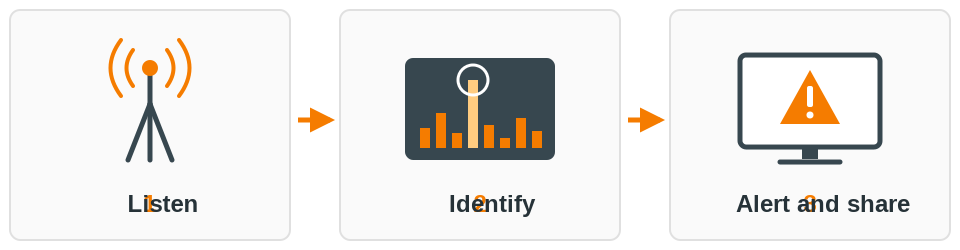
- Listen. Each sensor watches the frequency bands you choose, day and night. It only listens: it emits nothing to detect.
- Identify. On board, it spots each new emission, measures its frequency, level and timing, identifies its type when it matches a known signature or test, and logs every event.
- Alert and share. The network brings the results together. Operators get alerts in a web browser, and your command and control system receives the same picture through standard interfaces.
Our strengths
-
Our own technology
We design the software engine that runs every sensor, and the key hardware, including a wideband digitizer. A new capability reaches the whole fleet by software update.
-
Built to feed your C2
We contribute to your command and control system; we do not replace it. Our design isolates the C2 link in a single connector.
-
Open to your engineers
With PulseJS, your teams can add their own detectors, and your existing analysis software plugs into the network. Your algorithms remain yours.
-
Compact and affordable
The whole chain, from detection to reporting, fits in a compact, low-power unit run from a web browser. Priced to be deployed in numbers, not one at a time.
-
Rooted in research, from radar to satellites
Founded in 2016 by a former research engineer at ONERA, the French aerospace lab, who went on to direct the SONDRA radar laboratory. Our team also builds satellite ground stations and modems.
-
French, independent, compliant
An independent French company that complies with French regulations. We handle export licensing with the French authorities.
Latest news
- November 2026: Ten years of radio sensors
- November 2026: CloudSDR, our sensor network, is up and running
- June 2026: SPECTRA, maritime surveillance by drone, a France 2030 project with M3 Systems and SHERPA Engineering
- November 2025: linking our sensors across a whole territory
- April 2025: SDR-Technologies at SOFINS, the special forces event
Tell us about your mission.
We will tell you plainly what our sensors can and cannot do for it, and arrange a live demonstration on our test site near Paris.